Living on or near the water in Annapolis — whether your property backs up to Spa Creek, Back Creek, or one of the countless coves feeding into the Chesapeake Bay — comes with a tradeoff most waterfront homeowners eventually discover the hard way. The same brackish, humid air that makes evenings on your dock unforgettable is quietly working against nearly every building material you’ve installed outside. Wood decks warp and rot years ahead of schedule. Metal hardware rusts through. Even natural stone and paver sealants that perform beautifully inland can fail faster near the water than most homeowners expect.
This post breaks down exactly why waterfront exposure is so much harsher than a typical inland Maryland yard, and why stamped concrete — properly installed and sealed — holds up dramatically better than wood decking or sealed natural stone in that same environment.
Why Waterfront Air Is a Different Kind of Hostile
Salt air isn’t just “humid air with a coastal breeze.” It’s an active chemical process working against your outdoor structures around the clock, even on days when you can’t smell or feel it.
Salt air, also called marine aerosol, consists of tiny particles of sodium chloride and other salts carried inland from wave and wind action — often traveling several miles depending on wind patterns and topography. Once those particles land, the real damage begins. Salt is hygroscopic — it attracts and holds moisture — and acts as an electrolyte, promoting electrochemical corrosion. Salt particles land on a surface, absorb ambient moisture, and form a persistent salty film that speeds up oxidation on metals and breaks down protective coatings, paints, and organic materials. The cycle then repeats: corrosion creates rough, pitted surfaces that trap even more salt and moisture, worsening the damage over time. OCNJ DailyOCNJ Daily
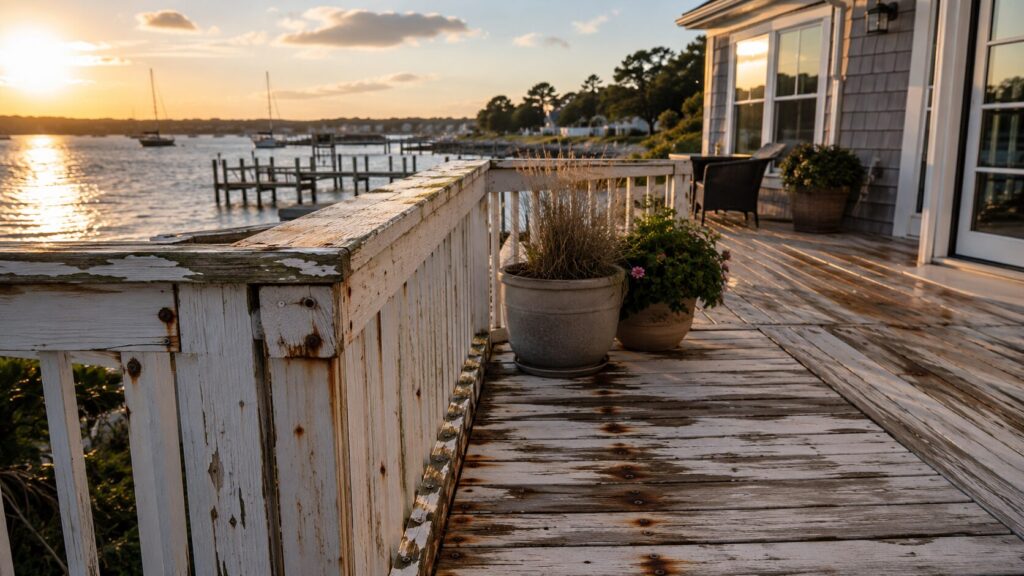
That compounding cycle is the key detail waterfront homeowners often miss. This isn’t a one-time exposure that fades — it’s a self-reinforcing process that accelerates the longer it’s left unaddressed. Corrosion can weaken structural elements like deck supports or fasteners within just a few years, creating real safety hazards, not just cosmetic ones. OCNJ Daily
What Salt Air Actually Does to Wood Decking
If you’ve owned a wood deck near Spa Creek or Back Creek for more than a few seasons, you’ve probably already noticed the symptoms: graying boards, splintering, a slight give underfoot near the railings. The mechanism behind that decline is well documented.
Salt water corrosion of wood decking happens fast in coastal exposure because the material is constantly exposed to salt in the air’s moisture, making it highly susceptible to accelerated decay. Salt residue left on a deck surface attracts moisture and speeds up corrosion and material breakdown — and unlike a rain shower, that salt doesn’t simply wash away on its own between storms. LushbudgetproductionAdvantageLumber
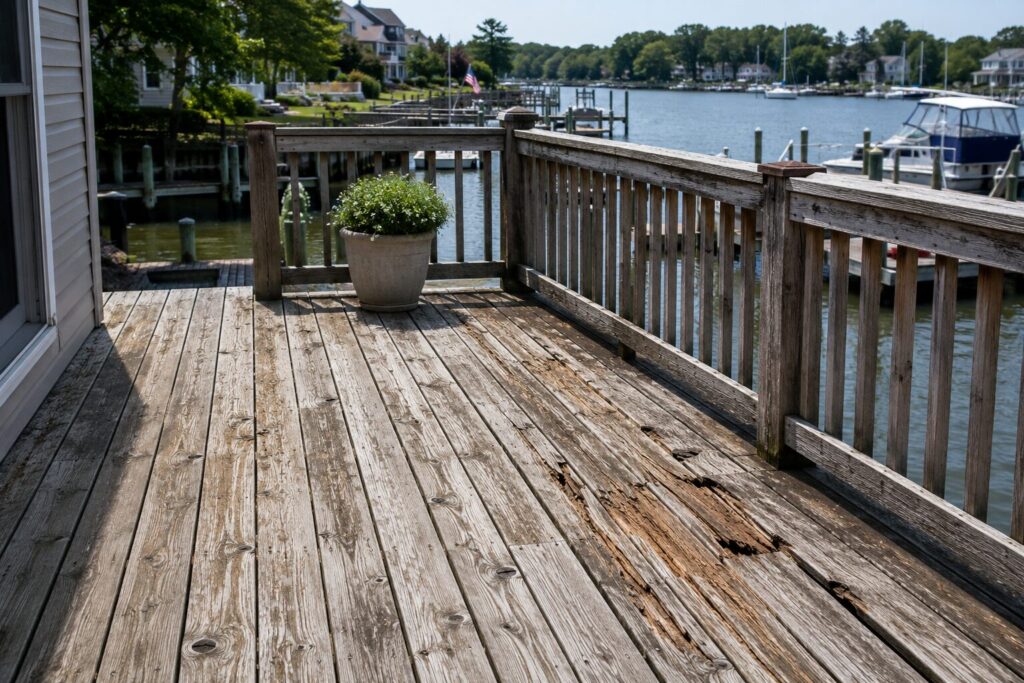
The damage isn’t limited to the visible boards, either. When salty ocean air settles on a deck, it pulls moisture into the surface of the wood, speeding up corrosion and rot, and that moisture works its way into fasteners and structural connections just as readily as it does the decking surface. Standard galvanized screws commonly used in deck construction can rust through in as little as 5–10 years in coastal areas — often failing well before the visible wood shows serious damage, which is precisely why waterfront deck failures can be more dangerous than they first appear. Batilucci BuildersWernerdecks
The lifespan numbers reflect this acceleration. Under normal inland conditions, a traditional wood deck typically lasts 10 to 15 years, and even well-maintained hardwoods max out well short of concrete’s lifespan. Add coastal salt exposure to that equation, and the numbers get worse, not better: high humidity and salt in the air can accelerate rot and cause faster warping if maintenance is skipped even briefly in a coastal environment — and on the Annapolis waterfront, “briefly” can mean a single missed season of resealing. TimberTechPreston Toor Site
Even the routine maintenance wood decking demands is more intensive near the water. Coastal decks should be resealed every 1–2 years to protect against moisture and salt air, compared to the 2–3 year interval typically recommended inland — meaning waterfront wood decks require roughly double the ongoing maintenance investment just to keep pace with standard performance. Wernerdecks
Why “Just Use Composite or Better Fasteners” Isn’t the Full Answer
Upgrading to composite decking or stainless steel hardware genuinely helps — stainless steel or galvanized fasteners prevent rust and corrosion from salt exposure, and composite or PVC decking resists moisture damage better than traditional wood — but it doesn’t eliminate the underlying problem, and it comes at a real ongoing cost. Even composite and PVC decking on the water needs regular rinsing with fresh water to prevent salt buildup, trimming nearby vegetation for airflow, and periodic inspection for warping, rust, or rot. You’re not escaping the maintenance cycle — you’re just slowing it down. WernerdecksWernerdecks
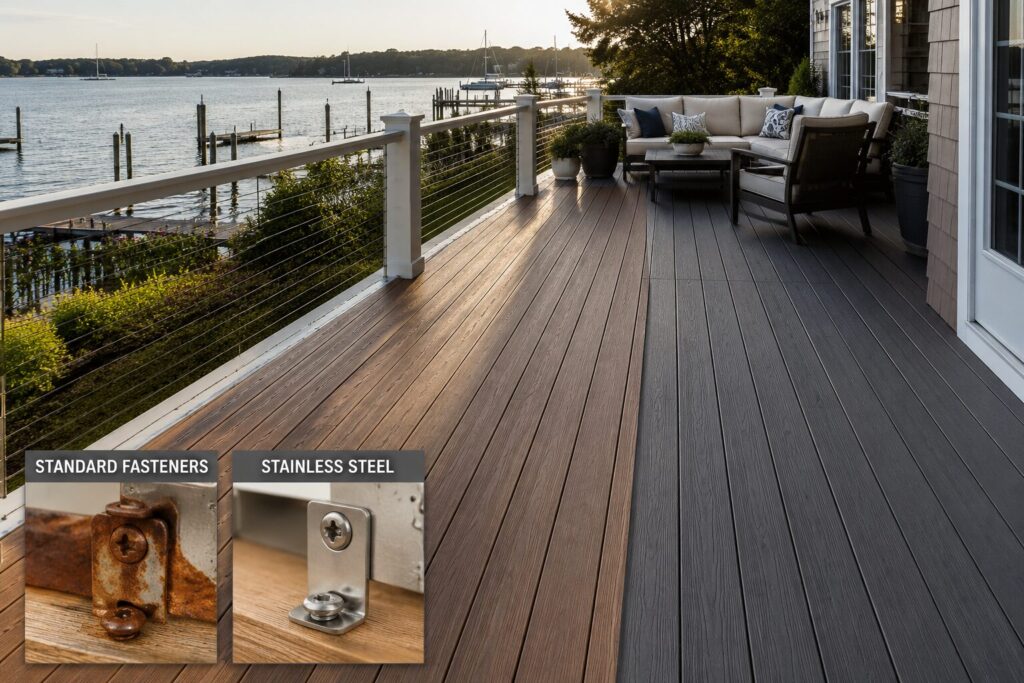
And upgraded decking materials still don’t solve the structural fastener problem entirely. Every screw, bracket, and structural connector below the surface remains vulnerable to the same corrosive process, regardless of what material sits on top of it.
Natural Stone and Paver Sealants Face Their Own Waterfront Problem
Homeowners who avoid wood in favor of natural stone or paver patios often assume they’ve sidestepped the salt-air issue entirely. In reality, they’ve traded one failure mode for a different one: efflorescence and sealant failure.
Efflorescence occurs when moisture collects in porous paver or stone materials and the heat from the sun draws that moisture, along with water-soluble salts, up to the surface. When the moisture evaporates, it leaves a random pattern of white or gray salt deposits on the surface — a cosmetic problem that becomes a structural one when handled incorrectly. Paver Rescue
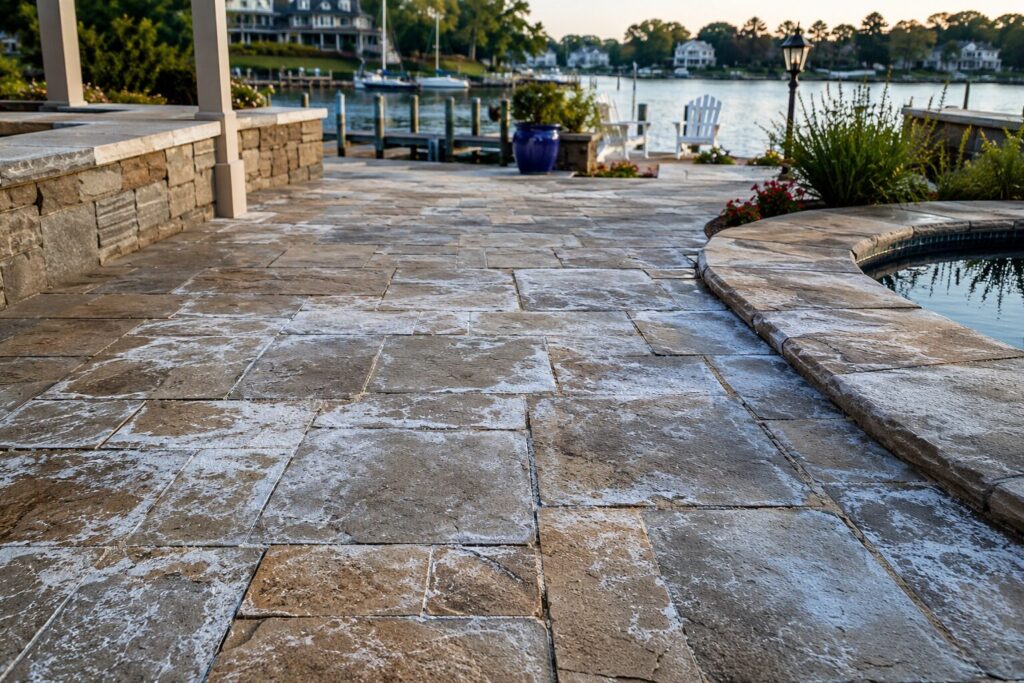
The waterfront environment makes this worse in a specific, technical way. If salts are stopped just below the sealed surface — a condition called cryptoflorescence — water still evaporates and deposits salts behind the surface, where they crystallize. Many homeowners experience expanding salt crystals that cause spalling or disintegration of the stone or brick when the wrong sealant is applied, or applied at the wrong time. This isn’t a rare DIY mistake — it’s common enough that industry sources specifically warn against sealing over unresolved efflorescence: if sealing occurs before efflorescence is fully treated, the minerals can become trapped beneath the coating, setting up exactly the failure mode described above. TropicalpaversealingThe Pinnacle List
Waterfront and high-humidity environments simply generate this problem more often and more severely. Travertine, concrete pavers, natural stone, and clay brick all react differently to moisture and sealant chemistry — a product suitable for one surface can create serious adhesion problems on another — which means a generic sealing approach that works fine on an inland patio can fail specifically because of the added salt load near Spa Creek or Back Creek. Add pool chemical exposure into the mix for waterfront homes with a pool, and the risk compounds further: sealing reduces corrosion risk from both pool chemicals and coastal salt exposure, but only when the right product is chosen and applied correctly for the specific material. The Pinnacle ListJUST SEAL IT
Where Properly Installed Concrete Has a Genuine Advantage
This is where stamped concrete earns its reputation as a materially different — and more durable — choice for waterfront hardscaping, provided it’s installed and sealed correctly for the environment.
Concrete’s baseline durability already outperforms wood by a wide margin, even before accounting for coastal exposure. With proper installation and drainage, a concrete patio can last up to 40 years, requiring only annual resealing and pressure washing, compared to a typical wood deck’s 10–15 years before major repairs are needed. Other independent estimates land in a similar range: concrete patios typically last 25–50 years, versus 10–15 years for a pressure-treated wood deck. VEVOR + 3
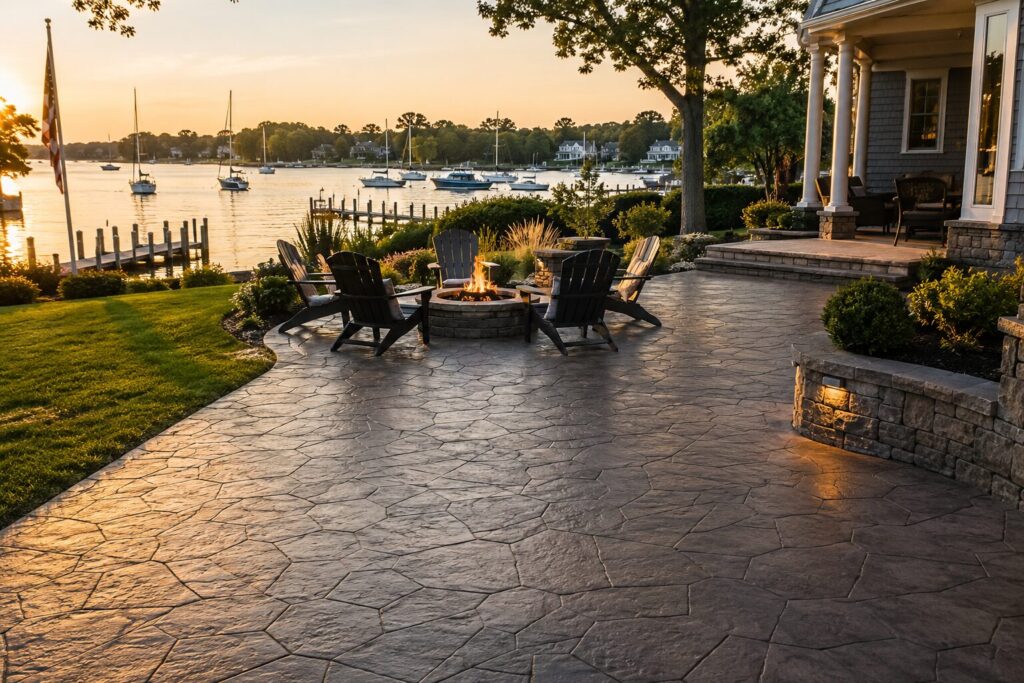
Concrete also avoids the specific failure mechanisms that make wood so vulnerable near the water. It has no organic fiber for salt-driven moisture to rot from within, and — unlike a raised wood deck — a poured concrete patio or walkway has no hidden fastener network of screws and brackets slowly corroding out of sight below the surface. The vulnerabilities are different, and they’re far more manageable: sealing addresses the main failure modes of outdoor paving by preventing efflorescence and reducing corrosion risk from coastal salt exposure, and because concrete is a monolithic, continuous surface rather than a jointed system, there are fewer entry points for salt-laden moisture to exploit compared to a paver patio’s network of joints. JUST SEAL IT
The caveat that matters most here: this durability advantage depends entirely on correct sealing for the specific waterfront environment. Penetrating sealers allow moisture to escape from inside the material while still protecting the surface, while film-forming sealers that sit on top can trap moisture underneath — precisely the mistake that causes efflorescence and spalling problems near the water. A contractor with genuine waterfront experience in Annapolis knows to specify the right sealer chemistry and timing for a Spa Creek or Back Creek property, not a generic inland formula. Hydro Wash 360
The Bottom Line for Waterfront Annapolis Homeowners
If you’re weighing a new walkway, patio, or pool deck on waterfront property, the salt-air math is worth taking seriously before you commit to a material. Wood decking, even upgraded with composite boards and stainless fasteners, requires meaningfully more frequent maintenance near the water than it would just a mile or two inland. Natural stone and standard pavers can look stunning but carry real risk of efflorescence-driven sealant failure if not treated and sealed with waterfront-specific expertise. Properly installed and sealed stamped concrete sidesteps both of these failure modes, delivering a genuinely lower-maintenance, longer-lasting surface for the specific conditions along Spa Creek, Back Creek, and the broader Chesapeake waterfront.
Maryland Curbscape is a locally owned, full-service concrete company based in Annapolis, with direct experience installing and sealing stamped and standard concrete for waterfront properties throughout the region. We understand what brackish air actually does to hardscaping — and how to build and seal a surface that’s genuinely built for it.
📞 Call 443-623-2068 to schedule your estimate and design consultation
📍 518 Tremont Circle, Annapolis, MD 21409
🔗 Contact Maryland Curbscape to get started online
Frequently Asked Questions
Why is salt air near Spa Creek or Back Creek worse for outdoor structures than regular humidity?
Because salt actively drives corrosion rather than just adding moisture. Salt is hygroscopic — it attracts and holds moisture — and acts as an electrolyte, promoting electrochemical corrosion. Salt particles land on a surface, absorb ambient moisture, and form a persistent salty film that speeds up oxidation and breaks down protective coatings, paints, and organic materials. That process repeats and worsens over time rather than staying constant. OCNJ Daily
How far inland does salt air actually travel from the water?
Farther than most people expect. Salt air particles from wave and wind action can travel inland several miles depending on wind patterns and topography — meaning properties that don’t sit directly on the water can still experience meaningful salt exposure, just at a lower intensity than true waterfront lots. OCNJ Daily
How much faster does a wood deck deteriorate near the water compared to inland?
Significantly faster. A wood deck under normal inland conditions typically lasts 10 to 15 years, but high humidity and salt in the air can accelerate rot and cause faster warping if maintenance is skipped even briefly in a coastal environment. Maintenance intervals also shrink: coastal decks should be resealed every 1–2 years, compared to the 2–3 year interval typically recommended inland. TimberTech + 2
Do the metal fasteners in a wood deck fail before the wood itself does?
Often, yes — and that’s part of what makes waterfront wood decks riskier than they look. Standard galvanized screws commonly used in deck construction can rust through in as little as 5–10 years in coastal areas, frequently failing well before visible wood damage appears, since the corrosion happens out of sight beneath the surface. Wernerdecks
If I upgrade to composite decking, does that solve the salt air problem?
It helps, but doesn’t eliminate it. Composite or PVC decking resists moisture damage better than traditional wood, but even composite and PVC decking on the water still needs regular rinsing with fresh water to prevent salt buildup and periodic inspection for warping, rust, or rot. The structural fasteners underneath remain just as vulnerable to corrosion regardless of what decking material sits on top. WernerdecksWernerdecks
Are natural stone patios immune to salt air problems since they’re not wood?
No — they face a different but equally real issue: efflorescence. Efflorescence occurs when moisture in porous stone or paver materials is drawn to the surface by heat, carrying water-soluble salts that leave white or gray deposits behind once the moisture evaporates. In coastal environments, this process happens more frequently and severely than inland. Paver Rescue
Can sealing a stone or paver patio make efflorescence worse instead of better?
Yes, if done incorrectly — this is a common and serious mistake. If salts are stopped just below a sealed surface — a condition called cryptoflorescence — water still evaporates and deposits salts behind the surface, where they crystallize. This can cause expanding salt crystals that lead to spalling or disintegration of the stone or brick, particularly when the wrong sealant type or timing is used. Tropicalpaversealing
Why can’t I just use one universal sealer on any patio material near the water?
Because different materials react differently to moisture and salt chemistry. Travertine, concrete pavers, natural stone, and clay brick all react differently to moisture and sealant chemistry — a product suitable for one surface can create serious adhesion problems on another. This is why waterfront-specific contractor experience matters more than it would for an inland patio. The Pinnacle List
How does stamped concrete’s lifespan actually compare to wood decking?
The gap is substantial even before factoring in coastal exposure. With proper installation and drainage, a concrete patio can last up to 40 years, requiring only annual resealing and pressure washing, compared to a typical wood deck’s 10–15 years before major repairs are needed. Other estimates put concrete patios at 25–50 years versus 10–15 years for a pressure-treated wood deck. VEVOR + 2
What kind of sealer should be used on stamped concrete in a waterfront environment?
A breathable, penetrating sealer is generally the safer choice near the water. Penetrating sealers allow moisture to escape from inside the material while still protecting the surface from stains and weather, while film-forming sealers that sit on top can trap moisture underneath — the same trapped-moisture problem that causes efflorescence and spalling in stone and paver installations. Getting this specification right is one of the main reasons waterfront-specific contractor experience matters. Hydro Wash 360
Have a waterfront patio, walkway, or pool deck project in mind? Call Maryland Curbscape at 443-623-2068, visit us at 518 Tremont Circle, Annapolis, MD 21409, or contact us online to schedule a design consultation.
Sources cited:
- OCNJ Daily — How Salt Air Creates Significant Challenges for Coastal Homes
- AdvantageLumber — How to Maintain a Deck in Coastal Climates
- Werner Decks — How Humidity & Salt Air Affect Decks
- Lush Budget Production — How Salt Air Damages Decks and Prevention Strategies
- Bartilucci Construction — Which Decking Materials Handle Coastal Weather Best?
- The Pinnacle List — Why Paver Sealing Failures Happen More Often in Coastal Florida Homes
- Just Seal It — Paver Sealer: How to Choose, Apply, and Make It Last
- Tropical Paver Sealing — Efflorescence: Removal & Prevention
- Paver Rescue — How to Prevent & Treat Efflorescence
- Paver Sealer Store — Efflorescence On Pavers: Causes, Removal & Prevention
- Hydrowash360 — What Causes White Spots on Pavers After Sealing?
- VEVOR Blog — Concrete Patio vs Wood Deck: Which Offers Better Value?
- Select Decks — Average Lifespan of a Deck & Patio
- TimberTech — How Long Does Decking Last? Material Lifespans