If you live on the water in Eastport, your daily walking pattern probably looks a little different than most homeowners’. You’re not just walking from your car to your front door — you’re walking from a wet, gently rocking dock, carrying gear, a cooler, or a line coil, straight onto your property with feet that are wet, bare, or in boat shoes with almost no tread left. Eastport maintains its nautical heritage as a bustling port, and for the neighborhood’s active sailing and boating community, that dock-to-house transition happens dozens of times a week during the season — which makes it one of the most overlooked safety and design opportunities on the whole property. Thetowerteam
This post covers why that specific stretch of walkway deserves more design attention than most homeowners give it, and how a properly specified, slip-resistant stamped concrete path can tie your dock gracefully into your home’s main entrance without turning that daily walk into a hazard.
The Wet-Foot Transition Is a Real, Well-Documented Risk
It’s easy to think of dock-to-yard slip risk as a minor inconvenience. Marina safety data and legal cases tell a different story.
Slips and falls from wet surfaces, uneven pavement, and poorly maintained walking areas are among the most frequent accidents at marinas and docks. The transition zones — exactly where a dock meets solid ground — are flagged repeatedly as particularly high-risk. Transition points from docks to boats, or from shore to ramps, are specifically identified as areas particularly prone to fall hazards, alongside dock surfaces themselves, which become slippery when wet, especially untreated wood or worn composite. Dwpersonalinjurylaw + 2
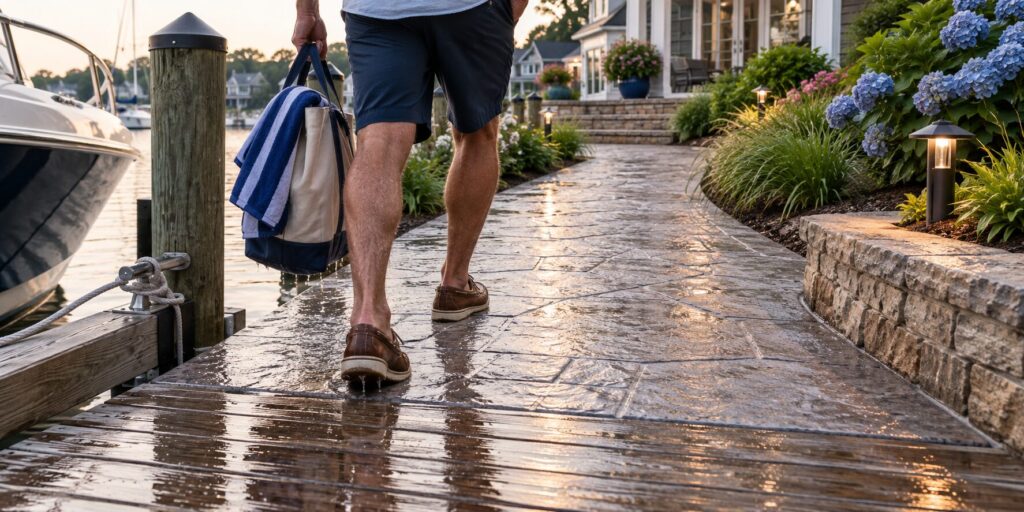
The injuries involved aren’t trivial. Fractures, torn ligaments, and joint injuries can happen when someone slips or falls near a dock, with some injuries requiring surgery and extended physical therapy. And this risk doesn’t disappear once someone steps off the dock itself — the same wet feet, the same reduced traction from boat shoes, and often the same heavy gear in hand continue right up the path to the house. Krupp & Raboin
Marina safety guidance for reducing this risk points directly at surface treatment as one of the most effective interventions available: facilities looking to reduce fall risk should regularly inspect walking surfaces and dock transitions, and consider upgrading to slip-resistant decking materials or applying anti-slip coatings where appropriate. That same principle applies just as directly to a private residential dock-to-patio walkway — the exact stretch of ground most Eastport waterfront homeowners walk across most often, and think about least. Maricorp
Why the Standard Sealed Finish Isn’t Enough Here
A beautifully finished stamped concrete walkway can still be a liability if the wrong sealer goes on top of it. This matters more for a dock path than almost any other surface on your property, because the foot traffic crossing it is wet nearly 100% of the time during boating season — not occasionally, the way a patio gets wet during a rainstorm.
The fix is a purpose-built anti-slip additive mixed directly into the sealer, rather than relying on the stamped texture alone. A clear plastic polymer grit additive, when mixed into a clear sealer, disappears to the naked eye but creates a rough surface underfoot once the sealer dries — especially noticeable, and most valuable, when the surface is wet. This is a well-established, widely used solution in the decorative concrete industry specifically for this problem: exterior decorative concrete installations commonly use a grit additive in the final sealer coat specifically to increase the coefficient of friction without sacrificing the finished look of the stamped pattern underneath. Concrete NetworkConcrete Network
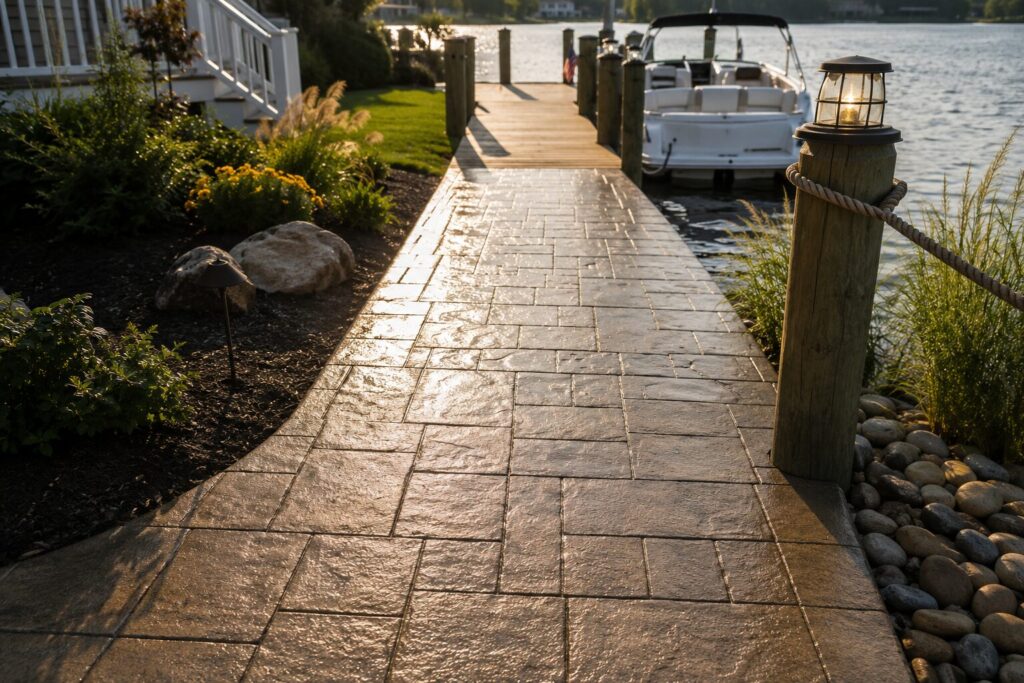
The comfort factor matters too, since bare or sandal-clad feet are the norm on a dock walkway. A properly mixed anti-slip additive provides a noticeable textured grip underfoot without making the surface feel rough or abrasive to bare feet — an important balance for a family that’s walking this path barefoot after swimming just as often as they’re walking it in boat shoes with gear in hand. Products designed for this exact use case are formulated with that balance specifically in mind: a properly selected slip-resistant additive is more comfortable to bare feet than sand or aggregate additives, and provides reliable traction even when wet without a rough, sandpaper-like feel underfoot. Direct Colors + 2
Stamped concrete specifically benefits from this approach because its texture already gives it a head start over smooth surfaces. A textured stamp system is known in the industry for its effectiveness in reducing surface slipperiness, and it’s so effective that its most common use case is around swimming pools and other wet environments where slip resistance matters most — a description that applies just as directly to a dock walkway as it does to a pool deck. SUNDEK
Designing the Path Itself: Tying Dock to Patio Gracefully
Beyond the slip-resistant sealer itself, the layout of the walkway matters just as much for both safety and everyday usability.
The goal is a continuous, uninterrupted visual and physical line from the dock to the main patio or entrance — no awkward material transitions, no uneven joints between sections, and no abrupt grade changes that create a trip hazard for someone carrying a cooler or a folded sail with both hands. A single, continuous stamped concrete surface accomplishes this in a way that a patchwork of pavers, gravel, and grass simply can’t: there’s no joint for a wet foot to catch on, no shifted paver to create an unexpected step, and no seam where two different materials meet at slightly different heights.
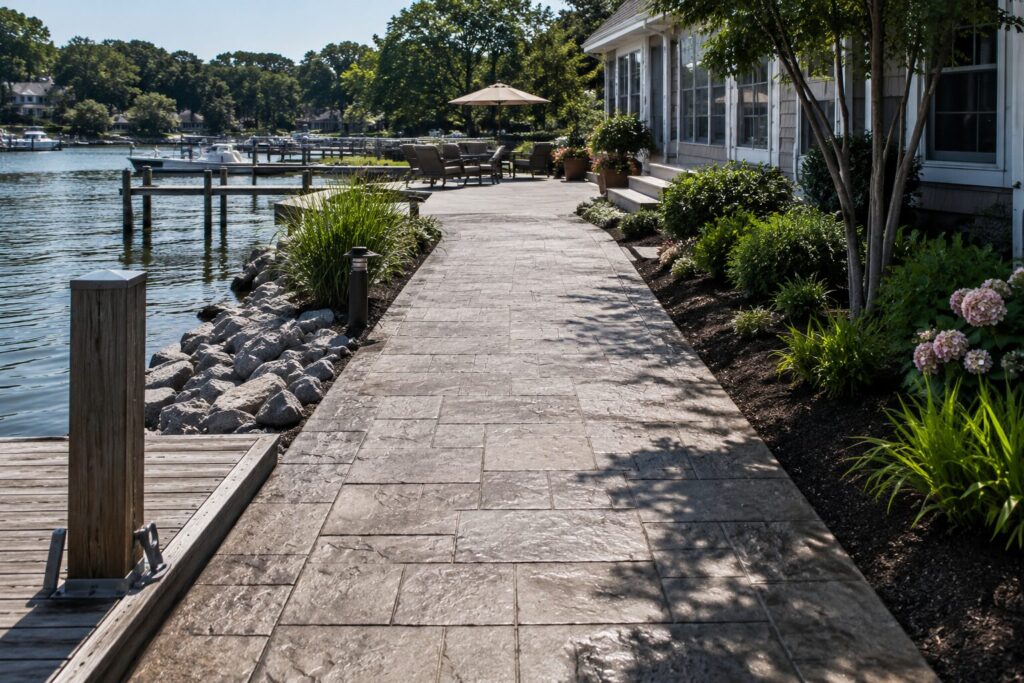
Width matters more here than on a typical garden path, too. Boaters frequently move gear, coolers, and even folded sails or paddleboards along this route — a narrow, meandering path that works fine for casual foot traffic becomes a genuine bottleneck (and a slip risk) when someone’s navigating it one-handed with the other hand full. Designing this specific walkway a few feet wider than a standard garden path, with a gentle, direct route rather than unnecessary curves, keeps the path functional for its actual daily use case rather than just its appearance in photos.
A Detail That’s Easy to Overlook — Until It’s a Problem
Most Eastport waterfront homeowners put real thought into their patio, their pool deck, and their dock itself. The connecting walkway between them tends to be an afterthought — often the original builder-grade path that’s been there since the house was built, never resurfaced, never re-sealed, and never actually assessed for how it performs specifically when wet.
Given how frequently that stretch of ground gets crossed with wet feet, boat shoes with minimal tread, and hands full of gear, it deserves the same deliberate design attention as the rest of the property — not because it’s the most visible feature of your home, but because it’s the one your family and guests use the most, in exactly the conditions where a slip is most likely.
Maryland Curbscape is a locally owned, full-service concrete company based in Annapolis, with direct experience designing and sealing slip-resistant stamped concrete walkways for Eastport’s waterfront properties. We understand exactly what a dock-to-house transition needs to hold up — and to be safe — for a boating family.
📞 Call 443-623-2068 to schedule your estimate and design consultation
📍 518 Tremont Circle, Annapolis, MD 21409
🔗 Contact Maryland Curbscape to get started online
Frequently Asked Questions
Is the dock-to-house walkway really a bigger risk than the dock itself?
It’s often overlooked, but the risk is real and well-documented. Transition points from docks to boats, or from shore to ramps, are specifically identified as areas particularly prone to fall hazards. The dock-to-house walkway carries the same wet-foot traffic as the dock itself, just further inland — meaning the risk doesn’t end where the dock does. Maricorp
What kinds of injuries actually happen from slips near docks and marinas?
They range from minor to serious. Slips and falls from wet surfaces, uneven pavement, and poorly maintained walking areas are among the most frequent accidents at marinas and docks, and fractures, torn ligaments, and joint injuries can happen when someone slips or falls, with some injuries requiring surgery and extended physical therapy. DwpersonalinjurylawKrupp & Raboin
Isn’t a textured stamped concrete pattern already slip-resistant enough on its own?
Texture helps, but it’s usually not enough on its own for a surface that’s wet almost constantly, like a dock walkway. A textured stamp system is known in the industry for reducing surface slipperiness, and it’s so effective that its most common use case is around swimming pools and other wet environments — but for consistently wet, high-traffic paths, pairing that texture with a slip-resistant sealer additive provides a meaningful additional safety margin. SUNDEK
What actually is an anti-slip sealer additive, and does it change how the concrete looks?
It’s a fine grit mixed directly into the sealer before application. A clear plastic polymer grit additive, when mixed into a clear sealer, disappears to the naked eye but creates a rough surface underfoot once the sealer dries — meaning your stamped pattern and color stay fully visible while the surface underfoot becomes noticeably grippier, especially when wet. Concrete Network
Will an anti-slip additive make the surface feel rough or uncomfortable barefoot?
Not if it’s properly specified. A properly mixed anti-slip additive provides a noticeable textured grip underfoot without making the surface feel rough or abrasive to bare feet, and a properly selected slip-resistant additive is more comfortable to bare feet than sand or aggregate additives. The goal is real traction without sacrificing comfort for a family walking the path barefoot after swimming. Direct ColorsW. R. Meadows
Does this kind of additive actually work when the surface is wet, not just damp?
Yes — that’s specifically what it’s designed for. The textured grit provides reliable traction even when wet, and grit additives are used specifically in exterior decorative concrete installations to increase the coefficient of friction in exactly these wet, high-traffic conditions. Direct ColorsConcrete Network
Do I need a wider walkway for a dock path than a typical garden path?
It’s worth considering, given how the path actually gets used. Boaters frequently carry coolers, folded sails, paddleboards, or other gear along this specific route — often one-handed. A walkway sized like a decorative garden path can become a genuine bottleneck and slip risk under that kind of real-world use, so a slightly wider, more direct route tends to perform better than a narrow, meandering one.
Can an existing dock walkway be resealed with anti-slip additive, or does it require a full replacement?
In many cases, resealing is enough — a full replacement isn’t always necessary. If the underlying stamped concrete or standard slab is still structurally sound, applying a fresh sealer coat with the right anti-slip additive mixed in can meaningfully improve traction without redoing the surface from scratch. If the existing surface has significant cracking or settling, a full resurfacing or replacement may be the better long-term fix.
Why does this matter more for Eastport specifically than other Annapolis neighborhoods?
Because of how frequently the dock-to-house transition actually gets used here. Eastport maintains its nautical heritage as a bustling port, and for its active sailing and boating community, that wet-foot walk from the water to the house happens routinely throughout the season — not as an occasional inconvenience, but as a daily pattern that deserves the same design attention as any other frequently used space in the home. Thetowerteam
Is this only relevant for homeowners with a private dock, or does it apply more broadly?
It applies most directly to waterfront homeowners with private dock access, but the underlying principle — that consistently wet, high-traffic walkways need purpose-built slip resistance, not just an attractive finish — applies to any Eastport property with a pool, a hose bib area, or any other spot where feet are wet more often than dry.
Have a dock-to-patio walkway that needs a safer, more graceful transition? Call Maryland Curbscape at 443-623-2068, visit us at 518 Tremont Circle, Annapolis, MD 21409, or contact us online to schedule a design consultation.
Sources cited:
- The Tower Team — Eastport MD Real Estate & Homes For Sale
- Weston & Pape — Liability for Injuries at Florida Marinas and Docks
- Maricorp — Slip, Trip and Fall Prevention Tips
- Krupp & Raboin Law Firm — Marina and Dock Injury Lawyer
- Direct Colors — Anti-Slip Additive for Concrete Sealer (OxiGrip)
- W.R. Meadows — SURE-STEP Slip Resistant Additive
- Concrete Network — How to Make Concrete Less Slippery
- Concrete Network — Non-Slip Concrete Sealer: Using Grit Additives for Traction
- SUNDEK — Is Stamped Concrete Slippery? 4 Non-Slip Solutions