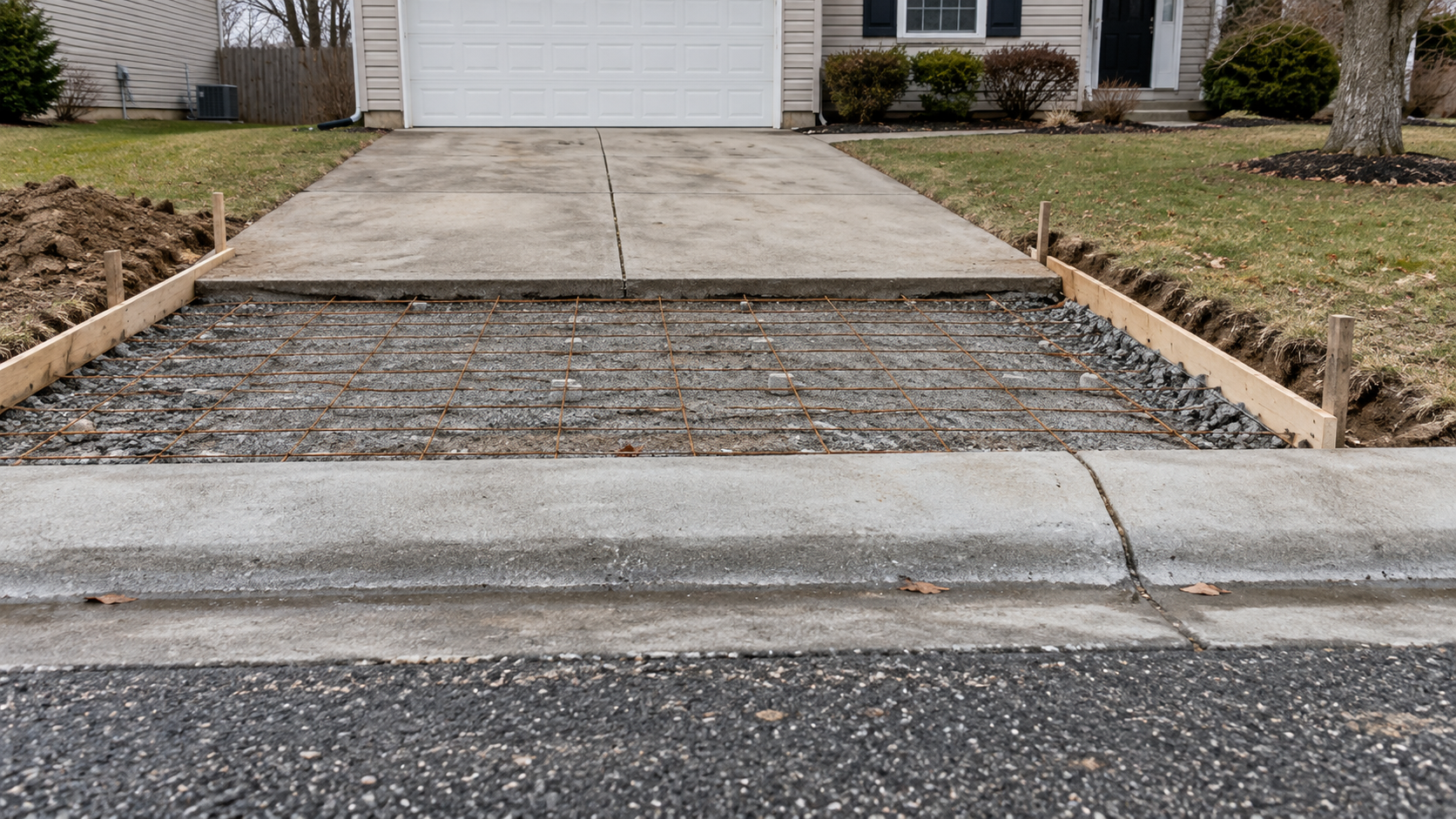
Neither a concrete driveway nor a ground-level patio requires a building permit in Anne Arundel County. But a driveway connecting to a county road needs a Residential Driveway Access Permit, and the apron must be poured at least 7 inches thick. The real approval questions here are grading plans, road access, and Chesapeake Bay Critical Area rules, not building permits. Confirm your specific address with the Anne Arundel County Department of Inspections and Permits (Permit Center, 2664 Riva Road, Annapolis, 410-222-7730) before you pour. See our concrete driveway installation in Anne Arundel County for project types.
This guide is for homeowners in Annapolis, Severna Park, Crofton, Cape St. Claire and nearby towns who want the project but do not want a stop-work order or a fine. Below is a quick reference, then the details by project type. For rules that carry money or measurements, verify the current figure with the county before you rely on it.
Quick reference: permits by concrete project type in Anne Arundel County
This list shows whether a permit is commonly required for concrete work in Anne Arundel County. Critical Area rules and grading thresholds can change the answer, so confirm your specific address with the county.
-
Concrete driveway (new or widened): No building permit. May need a Standard Grading Plan Application, Grading Permit, and/or DPW Right-of-Way approval.
-
Driveway connecting to a county road: No building permit, but a Residential Driveway Access Permit is required. Apron must be poured at least 7 inches thick.
-
Ground-level concrete patio: No building permit. A Standard Grading Plan Application may apply based on size and disturbed area.
-
Concrete walkway: Critical Area impervious limits can apply. Confirm with the county for your address.
-
Retaining wall over 24 inches: Yes. All retaining walls over 24 inches require a permit, residential and non-residential.
-
Decorative curbing / landscape edging: Generally no. Treated as low-profile landscaping, but confirm; Critical Area zones still matter.
Do you need a permit for a concrete driveway in Anne Arundel County?
A concrete driveway in Anne Arundel County does not require a building permit. What it may require is a Standard Grading Plan Application, a Grading Permit, and/or approval from the Department of Public Works for right-of-way work, depending on the size and how much soil is disturbed. Homeowners in established Severna Park and Arnold neighborhoods often replace a driveway in the same footprint, which disturbs less ground than a full expansion.
The bigger requirement is access. Any new or modified residential entrance onto a county road needs a Residential Driveway Access Permit, whether or not you remove curb and gutter. The county sets hard specifications here.
-
The apron and any adjoining sidewalk must be concrete, minimum 7 inches thick, using a county-approved mix.
-
No driveway may be placed within 50 feet of any intersection radius.
-
A second entrance is allowed only with a minimum of 100 feet of frontage, at county discretion.
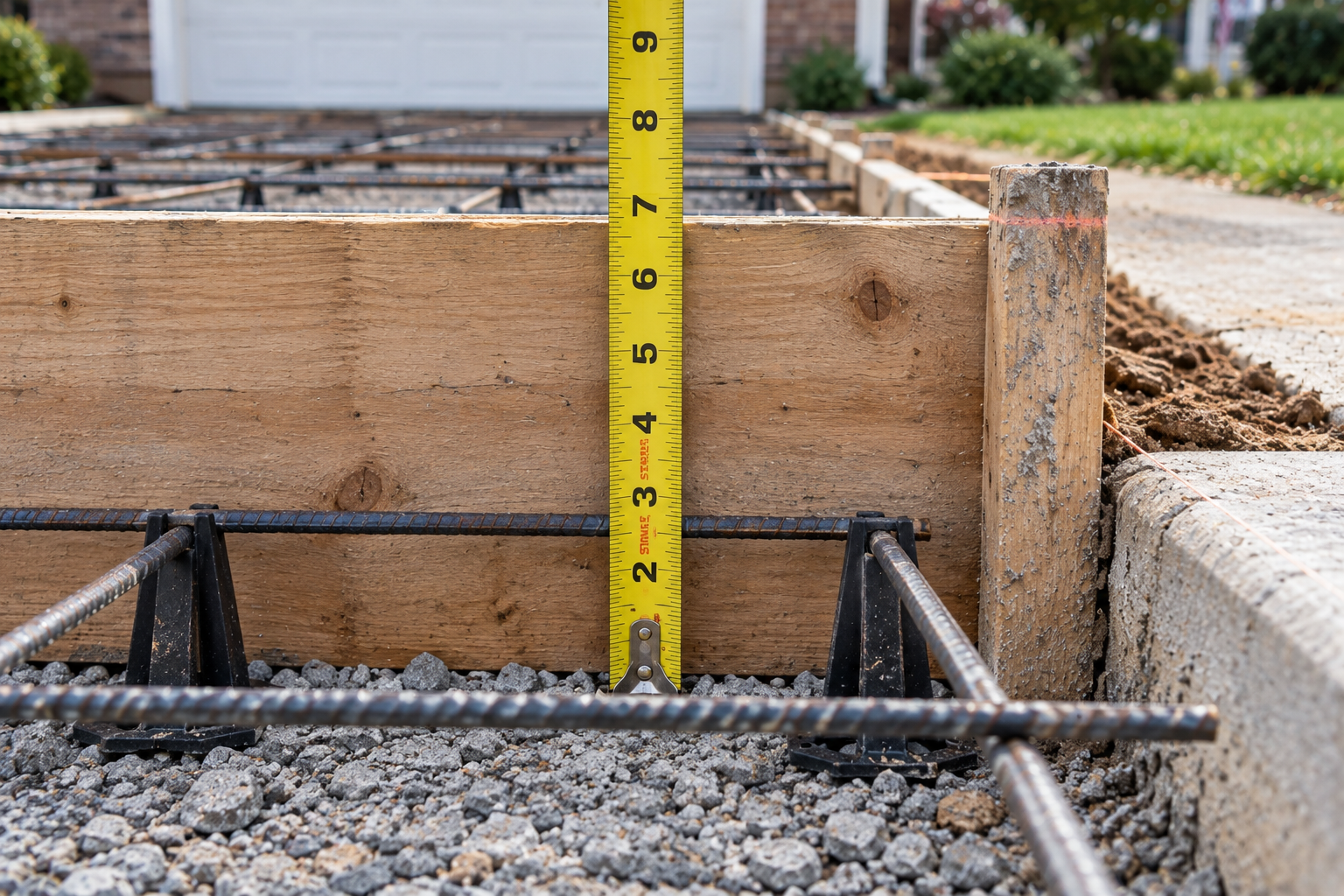
The 7-inch apron requirement is where cheap bids fall apart. A contractor who quotes a thin apron either does not know the county spec or is planning to skip it. Ask which approvals your driveway needs, and who is pulling them, before you schedule the pour.
Do you need a permit for a concrete patio in Anne Arundel County?
A ground-level concrete patio in Anne Arundel County does not require a building permit. What it may require is a Standard Grading Plan Application, based on the size of the patio and how much land is disturbed during construction. An unattached, on-grade patio in a Crofton backyard disturbs less ground than a large raised patio in Edgewater.
The answer changes when the patio stops being a simple slab. Adding a roof, a screened enclosure, or footings moves the project into building-permit territory. Attachment to the home and any change in grade also raise the review level.
Even when a patio needs no building permit, impervious surface still counts. A large patio adds hardscape that water cannot pass through, and on many lots the county tracks that through the grading plan.
Standard Grading Plan versus full Grading Permit in Anne Arundel County
Concrete driveway and patio projects in Anne Arundel County usually fall under a Standard Grading Plan Application, which covers smaller jobs. Exceeding any one of the county’s limits pushes the project into a full Grading Permit, which is a longer review. Per the Anne Arundel County Department of Inspections and Permits, a Standard Grading Plan covers you up to these thresholds:
-
Not more than 5,000 square feet of ground disturbed.
-
Cuts and fills not exceeding 10 feet in depth or height.
-
Not more than 100 cubic yards in volume.
-
No earth disturbance within 100 feet of perennial streams, 100 feet landward of tidal water, or 25 feet of non-tidal wetlands.
Projects in the Chesapeake Bay Critical Area must also include a Critical Area Worksheet. A driveway replacement in the same footprint in Severna Park often stays well under these limits, while a wide new patio on a sloped Arnold lot can trip the 5,000 square foot or 100 cubic yard threshold.
Concrete work in the Chesapeake Bay Critical Area
Concrete projects near tidal water in Anne Arundel County face extra rules under the Chesapeake Bay Critical Area program. The Critical Area covers all land within 1,000 feet landward of tidal waters or tidal wetlands. Many waterfront lots in Cape St. Claire, Annapolis, and along the Magothy and Severn Rivers fall inside this zone.
Inside the Critical Area, impervious surface is capped between 15% and 31% of the site, depending on the lot’s Critical Area designation. A new driveway, patio, or wide walkway counts toward that cap. There is also a 100-foot buffer from tidal water, which expands 4 feet for every 1% of slope beyond 15%.
Two more triggers catch homeowners here. Removing vegetation in the buffer requires an approved Vegetation Management Plan. Any disturbance over 5,000 square feet requires a grading permit. If your home is on or near the water, treat every concrete project as review-required until the county tells you otherwise.
One way to stay under the impervious cap is to add less hardscape in the first place. Concrete curbing and landscape edging carry a small footprint compared to a wide patio or an expanded driveway, so they add little toward the 15% to 31% limit. For a waterfront lot in Cape St. Claire or along the Magothy bumping against the cap, our decorative concrete curbing and landscape edging can define beds and drives without eating your allowance.
Concrete permits inside Annapolis city limits
Properties inside the City of Annapolis do not go through Anne Arundel County for permits. They go through the City of Annapolis, which runs its own permitting process. This catches homeowners on the boundary who assume the county rules apply to them.
If your address is inside the city line, confirm the process with the City of Annapolis rather than the county. The City of Annapolis Department of Planning and Zoning is the central point for all building and grading permit applications, with the DPW Stormwater Management team reviewing for stormwater. The city issues a Curb Cut Permit, its equivalent of the county’s Residential Driveway Access Permit, plus Sidewalk and Street or Sidewalk Opening permits.
The City does not publish a patio exemption the way the county does. The only residential building-permit exemption stated for work outside the Historic District covers non-structural replacement or repair of windows, doors and siding. So for a patio or driveway inside city limits, assume review applies until Planning and Zoning tells you otherwise.
City grading permit review runs three to four weeks, and the Anne Arundel Soil Conservation District charges a flat $150 on top of city fees. Those figures are the city’s timeline and fee, not the county’s.
HOA approval versus county permits in Anne Arundel County
An HOA approval and a county permit are two separate things in Anne Arundel County, and you may need both. The county controls building, grading, and access. Your homeowners association controls appearance, materials, and placement under its own covenants.
Many Anne Arundel HOA communities run active architectural review. Stamped concrete color, patio size, and driveway design can all require sign-off before work starts. HOA approval does not replace a county permit, and a county permit does not satisfy your HOA. For a fuller walkthrough, see our guide on what Anne Arundel homeowners need to know before starting an HOA-approved concrete upgrade.
Check your covenants and submit any architectural request early. HOA review can add weeks. Start that process at the same time you look into county approvals.
Retaining walls and steps: when height changes the rule
Concrete retaining walls in Anne Arundel County require a permit once they exceed 24 inches in height. This applies to residential and non-residential walls alike. Below 24 inches, a low decorative wall may be exempt, though Critical Area rules can still apply.
Sloped yards in Arnold, Pasadena and Severna Park often need walls to create usable, level space. A short garden edge and a soil-retaining structure are treated differently. When a wall is holding back a hillside, expect a review.
Concrete steps are the one project the county’s published permit guidance does not address directly. Whether steps need a permit comes down to height and whether they are structurally attached to the house. A couple of steps up to an on-grade patio is a different project from a tall run tied into the foundation. The county’s Permit Center at 410-222-7730 can confirm for your design before you build.
What happens if you skip the permit
Skipping a required grading or access permit in Anne Arundel County can lead to a stop-work order and orders to correct or remove the work. The county can require an already-poured slab or apron to be corrected or torn out if the required approval was never obtained.
Unpermitted concrete can also surface when you sell. Buyers and inspectors flag work with no permit record, which can stall a sale in Annapolis or Davidsonville. Fixing it after the fact usually costs more than doing it right the first time.
A licensed contractor should know which approvals your project needs and pull them for you. Confirm who is responsible for each permit before work begins, in writing.
Hiring a licensed concrete contractor in Anne Arundel County
Concrete driveway work on an existing home is home improvement under Maryland law, which means the contractor doing it must hold a Maryland Home Improvement Commission license. The statute names driveways directly in its definition of home improvement, and there is no minimum dollar amount. The licensing requirement applies regardless of job size. Ask for the license number and verify it with the state before you sign.
A local contractor who works across Glen Burnie, Pasadena and Annapolis knows the county grading and access process and the Critical Area rules. Local knowledge shortens the approval path and means fewer surprises on waterfront and sloped lots. You can compare our stamped concrete patios and driveways and concrete driveway installation to see which project fits your yard and your approval path.
Get a free estimate from Maryland Curbscape
Maryland Curbscape installs concrete driveways, patios, walkways, steps, retaining walls, stamped concrete, and decorative curbing across Anne Arundel County. We serve Annapolis, Severna Park, Arnold, Crofton, Edgewater, Cape St. Claire, Pasadena, Davidsonville and Glen Burnie. We can walk your property and help you understand which approvals your project may need.
Call 443-623-2068 for a free estimate. We are locally owned and based in Annapolis at 518 Tremont Circle.
Please verify this information yourself. These requirements come from Anne Arundel County, City of Annapolis and State of Maryland sources current as of August 2026. Rules, thresholds and fees change, and how they apply depends on your property: its size, slope, proximity to tidal water and jurisdiction. Confirm your address with the Anne Arundel County Department of Inspections and Permits (2664 Riva Road, Annapolis, 410-222-7730), or the City of Annapolis Department of Planning and Zoning if you are inside city limits. This guide is general information, not legal or engineering advice.
Before you start work, confirm the requirements for your address with the Anne Arundel County Department of Inspections and Permits, Permit Center, 2664 Riva Road, Annapolis, 410-222-7730. If your property is inside Annapolis city limits, contact the City of Annapolis Department of Planning and Zoning instead.
This guide is general information, not legal, engineering or regulatory advice.
Frequently Asked Questions
Do I need a permit to replace my existing driveway in the same footprint?
Replacing a concrete driveway in the same footprint does not require a building permit in Anne Arundel County, and it usually stays within the Standard Grading Plan limits because it disturbs less ground than an expansion. The exception is the entrance itself. If the work modifies where the driveway meets a county road, a Residential Driveway Access Permit is required, whether or not curb and gutter is removed.
How do I find out if my property is in the Chesapeake Bay Critical Area?
The Chesapeake Bay Critical Area covers all land within 1,000 feet landward of tidal waters or tidal wetlands, so most waterfront and near-waterfront lots in Cape St. Claire, Annapolis, Edgewater and along the Magothy and Severn Rivers fall inside it. Your lot's specific designation determines the impervious surface cap, which runs between 15% and 31%. The Anne Arundel County Office of Planning and Zoning can confirm both for your address, and any grading application inside the Critical Area must include a Critical Area Worksheet.
Do I need a permit for concrete curbing or landscape edging?
Concrete curbing and landscape edging are generally treated as low-profile landscaping in Anne Arundel County and do not require a building permit. Critical Area rules still apply, though. Curbing is an impervious surface and counts toward the 15% to 31% cap on lots inside the Critical Area, even though its footprint is small compared with a patio or driveway. Confirm with the county if your property is near tidal water.
Who pulls the permit, me or my contractor?
Either you or your contractor can pull the permits, but agree it in writing before any work starts. A contractor licensed through the Maryland Home Improvement Commission should know which approvals a project needs in Anne Arundel County and handle them as part of the job. If a contractor tells you no approvals are needed for a new driveway entrance onto a county road, treat that as a warning sign.