Chesapeake Avenue is where Eastport’s century-old cottages sit beside brand-new waterfront construction — and both deserve hardscaping that fits the street’s proud maritime character. This guide breaks down how brick and cobblestone stamped concrete patterns, paired with the right border treatment, give any property genuine historic charm and lasting curb appeal.
For Eastport’s boating community, the walk from dock to backyard happens dozens of times a week — usually with wet feet, worn boat shoes, and hands full of gear. This guide breaks down why that specific stretch of ground deserves real design attention, and how a properly sealed, slip-resistant stamped concrete path ties your dock gracefully into your home.
Eastport’s historic cottages and bungalows are famous for their charm — and their tight, often awkwardly shaped lots. This guide shows how the right stamped concrete pattern, color, and layout strategy can turn a narrow or irregular Eastport yard into a genuinely elegant entertaining space, without sacrificing an inch of the neighborhood’s character.
The same brackish air that makes waterfront living in Annapolis so appealing is quietly working against your deck, patio, or walkway. This guide breaks down exactly how salt air destroys wood decking and causes paver sealant failures near Spa Creek and Back Creek — and why properly installed stamped concrete holds up dramatically better for the long haul.
Before a single buyer sees your kitchen, they see your driveway. With Maryland’s fall market heating up and winter freeze-thaw damage looming, this guide breaks down the real ROI data behind driveway and walkway upgrades — and why now is the smartest time to invest in your curb appeal before listing.
If you live in one of the many townhomes or smaller single-family lots scattered across Columbia and Silver Spring, you’ve probably had the same thought while scrolling through outdoor living inspiration: “That looks amazing, but my yard isn’t big enough for something like that.” It’s one of the most common assumptions homeowners make before calling a concrete contractor — and it’s almost always wrong.
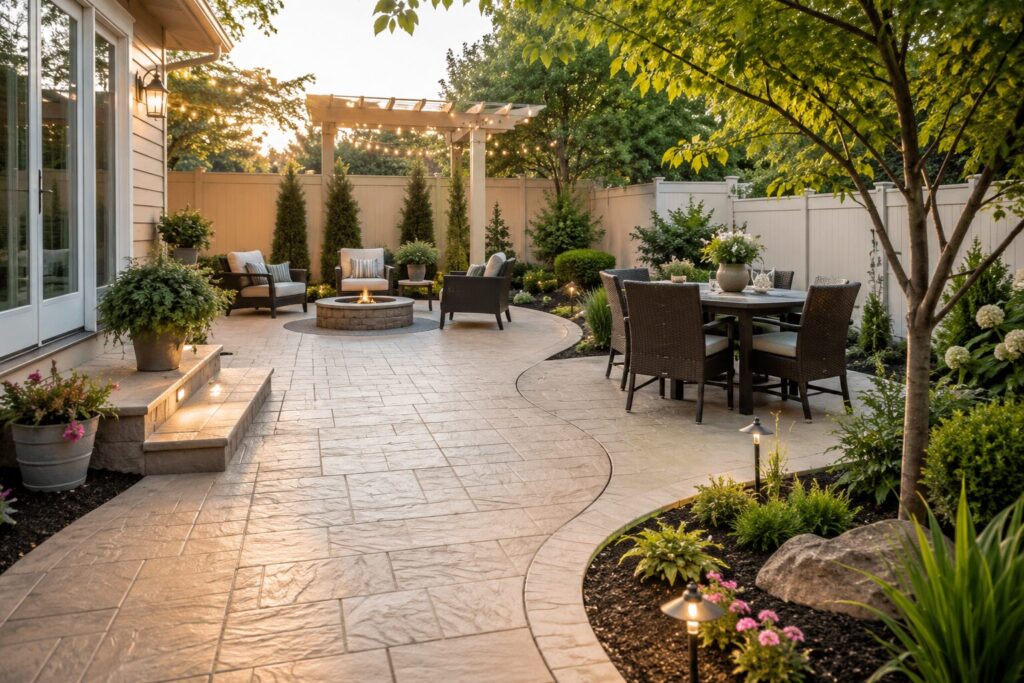
A small footprint doesn’t rule out a genuinely luxurious outdoor space. It just changes the design approach. With the right layout, color strategy, and a few smart built-in features, a compact suburban yard can feel like a private retreat rather than a leftover strip of grass behind the house. Here are five patio design approaches that work especially well on the smaller lots common throughout Columbia, Silver Spring, and similar Maryland suburbs — along with the design principles behind why they work.
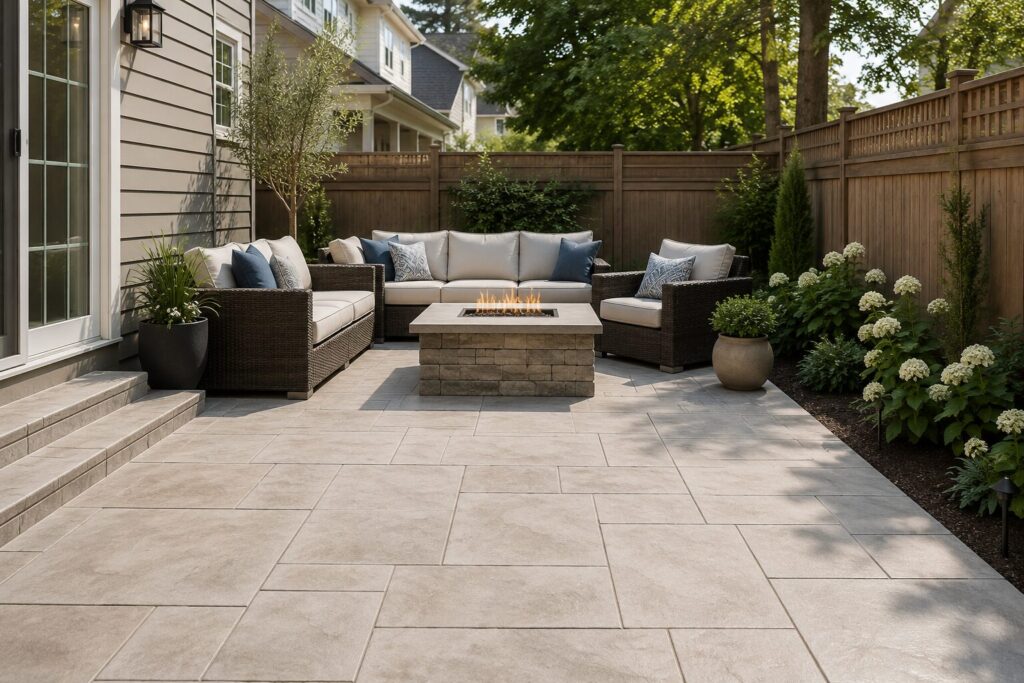
1. The Light-Reflective Stamped Concrete Slab
The single biggest design lever for making a small patio feel larger isn’t layout — it’s color. Light-colored building materials, especially flooring, don’t just keep a patio cooler; they also create the perception of a larger living area. Allied Outdoor Solutions
This isn’t a minor stylistic preference — it’s rooted in how the eye reads enclosed space. Dark surfaces absorb light and make the edges of a space appear closer, while light-colored surfaces reflect sunlight and brighten the patio, softening the boundaries so they appear farther away. For a small backyard hemmed in by a fence line or neighboring homes — extremely common in Columbia’s more established communities — that visual softening genuinely changes how the space feels to stand in, not just how it photographs. Natural Stone Pavers
The most effective tones for this effect are consistent across design guides: soft olive limestone, light silver-gray, sandstone tones, and pale porcelain-look concrete all read as open and airy rather than closed-in. Stamped concrete is particularly well-suited to this strategy because homeowners increasingly choose stamped concrete finishes with subtle textures and lighter tones specifically because they create a sense of depth while keeping the space feeling open and airy, and large-format textures, soft earth-tone finishes, and matte sealers give smaller patio layouts a clean, modern aesthetic perfectly suited to compact spaces. Natural Stone Pavers + 2
Design tip: a large-format stamped pattern — think oversized flagstone or ashlar slate — reads as more spacious than a busy, small-repeat brick pattern, which can visually shrink a small patio by breaking it into too many small segments.
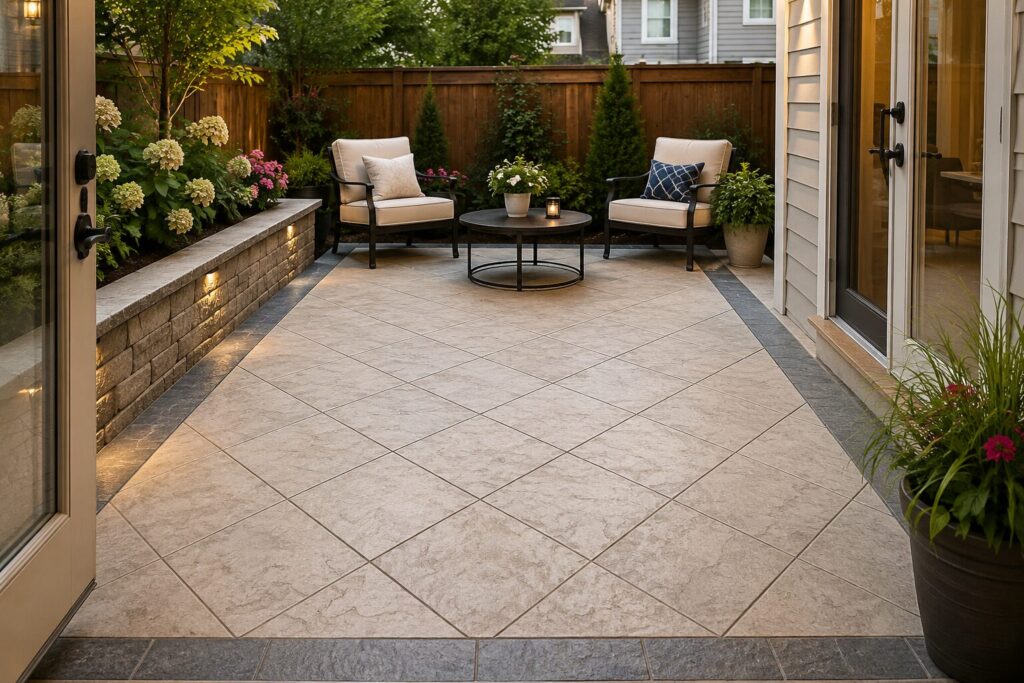
2. The Diagonal-Pattern Patio for Visual Flow
Beyond color, the direction and orientation of a stamped or scored pattern can meaningfully change how large a space feels — and it’s one of the most overlooked tools available to a small-yard design.
A diagonal or angled joint pattern guides the eye diagonally across a space, and that diagonal movement usually makes a patio look wider than its true dimensions. The key is orientation relative to the house: the pattern should align with the main viewing angle from the home, so that when someone looks out from a door or window, the pattern guides their eye toward the yard rather than across it. This is a small, almost invisible design decision on paper, but it has an outsized effect on how “big” a compact patio feels once you’re standing on your back porch looking out. Natural Stone PaversNatural Stone Pavers
A well-placed border amplifies this further. A thin, contrasting border around the perimeter — typically 4 to 8 inches wide — acts like a picture frame: it defines the shape of the space while keeping the interior simple, which expands the visual field rather than shrinking it. On a stamped concrete patio, this can be achieved with a subtle color or texture break at the edge, giving the space a finished, intentional look without adding any visual clutter. Natural Stone Pavers
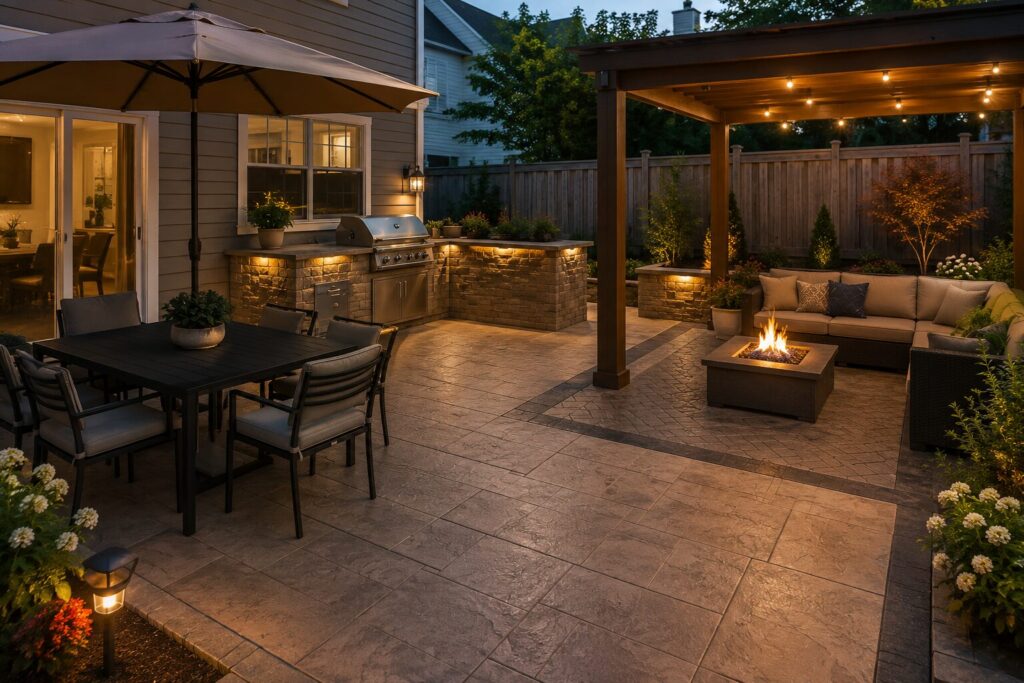
3. The Zoned Multi-Purpose Slab
On a small lot, every square foot of hardscape has to earn its place. That means the most successful compact patios aren’t just smaller versions of large ones — they’re purpose-built to layer multiple functions into a single footprint.
In smaller backyards, every section of the patio needs to serve a purpose, and homeowners are increasingly designing compact patios that support multiple functions within one connected layout. The trick to making this feel cohesive rather than crowded is subtlety in the transitions: decorative concrete allows different zones — dining, lounging, cooking — to feel visually connected while still separating spaces through subtle texture or color variation, which helps small patios function more efficiently without feeling overcrowded. DallasdecorativeconcreteDallasdecorativeconcrete
This zoning approach pairs well with a few space-saving structural choices that designers use specifically for compact outdoor rooms: vertical space is a small patio’s best friend — walls, support columns, and shade structures offer opportunities to “design upward,” and features like built-in island storage reduce clutter and add usable square footage without expanding the footprint, while recessed overhead lighting frees up ground space that would otherwise be needed for lamps or string-light posts. On a Columbia or Silver Spring lot where the patio might run 12 by 16 feet total, these choices are what separate a space that feels genuinely finished from one that feels like a slab with furniture crammed onto it. Allied Outdoor SolutionsAllied Outdoor Solutions
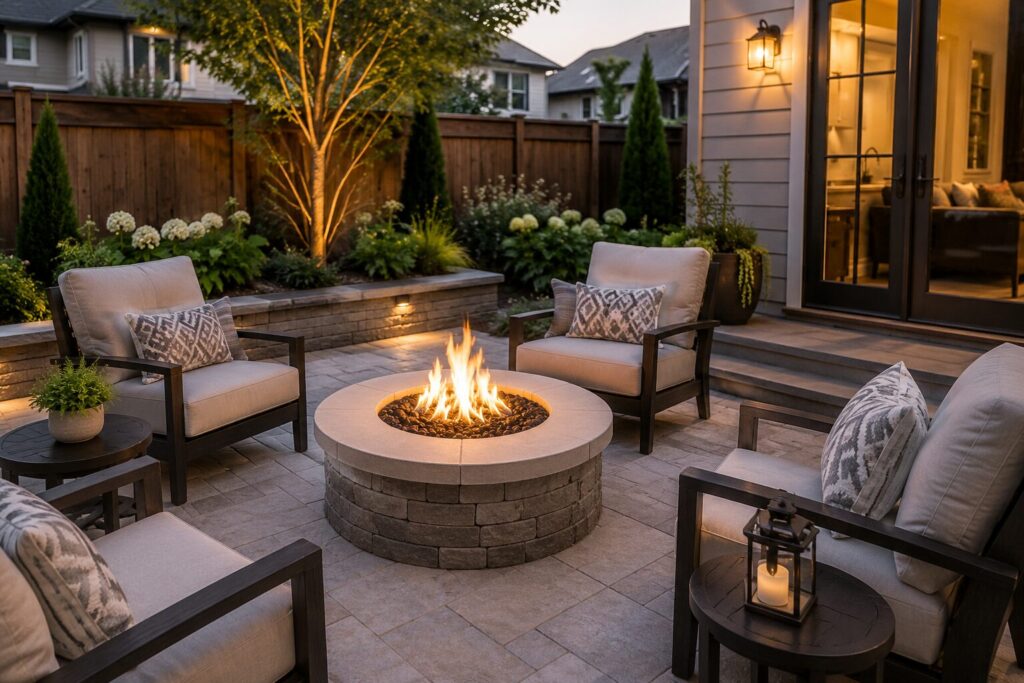
4. The Compact Built-In Fire Pit Layout
A built-in fire pit is often the single feature homeowners assume their yard is “too small” for — but with the right sizing, it’s one of the most achievable luxury upgrades for a compact patio.
The key is matching fire pit size to available space rather than defaulting to a large, statement-piece design. On a smaller patio, sticking to a fire pit under 36 inches wide does the job without making the space feel cramped, and one commonly cited design rule frames it even more precisely: a fire pit and its surrounding safe zone should take up no more than one-third of total patio area — so on a 12×12 foot patio, a 36–44 inch fire pit is the appropriate range, while larger units are better suited to bigger spaces. Fire Pit SurplusDreamcastdesign
Fuel type also plays a major role in how much of your compact patio a fire feature will actually consume. Gas fire pits burn cleaner and more contained, allowing for a comfortable seating distance of around 18 to 24 inches, while wood-burning designs need considerably more breathing room to account for heat and embers. For small Columbia or Silver Spring patios specifically, a built-in gas fire feature is almost always the more space-efficient choice — it lets you keep seating closer without sacrificing safety, which matters enormously when every foot of patio is doing double duty. Dreamcastdesign
A reasonable, well-supported sizing guideline for a small-to-mid patio: a small pit in the 30–36 inch range comfortably suits a 7–8 foot seating area for two to four people, which fits neatly within many suburban patio footprints without overwhelming the rest of the design. Backyard Oasis
5. The Expanded-Illusion Patio with Curved Edges and Framing Elements
The final approach borrows from garden design rather than hardscape design directly, but it pairs beautifully with a stamped concrete patio and is especially effective on small, boxy suburban lots.
Curved paths and edges help a yard feel calm and full of life even when the footprint is small, since the curves hide parts of the yard and add a sense of discovery rather than revealing the entire boundary at a glance. Combined with a lighter overall palette — light-colored fencing, walls, or gravel paths reflect sunlight and make a small space feel less cramped and more open — this creates a layered, “you can’t see it all at once” effect that makes a compact backyard feel considerably larger than its actual square footage. aolaol
This is also where thoughtful, incremental additions matter more than one big renovation. Homeowners with a small existing concrete patio can expand it strategically — by pouring an addition to increase square footage, adding stamped concrete pavers to extend the usable area, or resurfacing an aging slab to refresh its color and finish — all approaches that let you grow into a larger outdoor living space over time rather than requiring a full teardown and rebuild from day one. Concrete Network
Small Lot, Real Results
None of these approaches require a sprawling backyard to pull off. They require the right combination of color, pattern orientation, zoning, and proportional feature sizing — decisions that are far easier to get right with a contractor who’s actually walked your specific lot and understands how Columbia and Silver Spring’s typical suburban footprints behave. A design that looks stunning in a magazine spread photographed in a half-acre yard can feel completely wrong scaled down to 400 square feet without these adjustments.
If your yard has felt “too small” for the kind of outdoor space you actually want, it’s worth a conversation before you rule it out.
Maryland Curbscape is a locally owned, full-service concrete company based in Annapolis, specializing in standard and stamped concrete patios, walkways, and outdoor living spaces throughout Maryland — including compact suburban lots in Columbia and Silver Spring. We’ll walk your specific yard and show you what’s actually possible with the space you have.
📞 Call 443-623-2068 to schedule your estimate and design consultation 📍 518 Tremont Circle, Annapolis, MD 21409 🔗 Contact Maryland Curbscape to get started online
Frequently Asked Questions
Can a small backyard really support a premium hardscape design?
Yes — the design approach just needs to adapt to the footprint. Many smaller outdoor spaces are being transformed into highly functional, stylish extensions of the home through smarter layouts and decorative concrete solutions, rather than being scaled-down versions of large-yard designs. The key differences are color, pattern orientation, and proportional feature sizing — not the absence of luxury elements. Dallasdecorativeconcrete
Does the color of my patio really affect how big it feels?
Significantly, yes. Light-colored flooring materials don’t just keep a patio cooler — they also create the perception of a larger living area. This happens because dark surfaces absorb light and make the edges of a space appear closer, while light-colored surfaces reflect sunlight and soften the boundaries so they appear farther away. Tones like soft limestone, light silver-gray, and sandstone consistently outperform darker finishes for making compact spaces feel open. Allied Outdoor Solutions + 2
What patio pattern works best for a small yard?
A diagonal or angled joint pattern is generally the most effective. Diagonal joints guide the eye across the space, and that movement typically makes a patio look wider than its true dimensions — especially when the pattern is aligned with the main viewing angle from the house, so it draws the eye out toward the yard when looking through a door or window. A thin contrasting border around the edge can reinforce this effect further. Natural Stone PaversNatural Stone Pavers
Can a small patio really fit a fire pit without feeling cramped?
Yes, as long as the fire pit is sized correctly. On a smaller patio, sticking to a fire pit under 36 inches wide does the job without making the space feel cramped. A useful rule of thumb: a fire pit and its surrounding safe zone should take up no more than one-third of total patio area — so a 12×12 foot patio comfortably supports a 36–44 inch fire pit. Fire Pit SurplusDreamcastdesign
Should I choose a gas or wood-burning fire pit for a compact patio?
Gas is generally the more space-efficient choice for smaller footprints. Gas fire pits burn cleaner and more contained, allowing for a comfortable seating distance of around 18–24 inches, while wood-burning fire pits need considerably more clearance to account for heat and flying embers — clearance that’s harder to spare on a compact patio. Dreamcastdesign
How much clearance does a built-in fire pit actually need?
It depends on size and fuel type, but general guidance suggests at least 2 feet of clearance on all sides, with about 4 feet of space allotted per seated person. For a small pit in the 30–36 inch range, that translates to roughly a 7–8 foot total area, comfortably seating 2–4 people. Always confirm specific setback requirements with your local fire code before finalizing placement. Backyard OasisBackyard Oasis
Can I add multiple “zones” — dining, lounging, a fire feature — to one small patio?
Yes, and it’s one of the more effective strategies for compact yards. Decorative concrete allows different zones to feel visually connected while still separating spaces through subtle texture or color variation, which lets a single small slab support multiple functions without feeling overcrowded. Features like built-in island storage and recessed overhead lighting also help free up ground-level space that furniture would otherwise occupy. DallasdecorativeconcreteAllied Outdoor Solutions
My existing patio is too small — do I need to tear it out and start over?
Not necessarily. A small existing concrete patio can often be expanded by pouring an addition to increase square footage, adding stamped pavers to extend the usable area, or resurfacing the slab entirely to refresh its color and finish — all of which let you grow the space incrementally rather than requiring a full teardown. Concrete Network
Does using curved edges or paths actually make a yard feel bigger?
Yes — this is a well-established garden design principle. Curved paths and edges help a yard feel calm and full of life even when it’s small, because the curves hide parts of the yard and add a sense of discovery instead of revealing the full boundary in one glance. This works especially well when paired with the light-color strategy described above. aol
What’s the biggest design mistake homeowners make on small patios?
Choosing a busy, small-repeat pattern or a dark color palette that visually shrinks the space. Large-format textures, soft earth-tone finishes, and matte sealers give smaller patio layouts a clean, modern aesthetic, while small, high-contrast repeat patterns tend to break the eye’s read of the space into fragments — making a compact patio feel more cramped rather than less. Dallasdecorativeconcrete
Ready to see what your yard can actually support? Call Maryland Curbscape at 443-623-2068, visit us at 518 Tremont Circle, Annapolis, MD 21409, or contact us online to schedule a design consultation.
Stamped concrete or pavers — it’s the decision every Annapolis homeowner planning a new patio or walkway eventually faces. Both deliver the same high-end stone or brick look, but they age very differently. This guide breaks down real installation costs, long-term maintenance, weed and pest prevention, and design flexibility so you can choose with confidence, not guesswork.
Annapolis just weathered an Extreme Heat Warning with a heat index over 110°F — and if your pool deck is dark, aging concrete or standard pavers, it’s probably too hot to walk on barefoot by 10 a.m. This post breaks down what the data actually says about surface temperature, slip resistance, and why the right stamped concrete color and sealant can solve both problems at once for Maryland homeowners.
For most of the year, hydrangeas do the heavy lifting in a Maryland garden. The harder design question is whether the bed still looks finished in February, when the blooms are gone and the shrubs are bare. That’s where good design earns its keep: a clean curbed border holding the composition, evergreen structure for winter, a thoughtful layout, and a curb color that makes the blooms pop. Here’s how to design a hydrangea bed that reads as custom all twelve months.
Hydrangeas are a Maryland staple, and a clean concrete curb is one of the best ways to frame a hydrangea bed — it defines the planting, holds the mulch, and makes everything look custom. But there’s a wrinkle almost no landscaping article mentions: concrete leaches lime, raising nearby soil pH, which can nudge blue hydrangeas toward pink. The fix is design, not avoidance. Here’s how to curb around hydrangeas while keeping your blooms true.